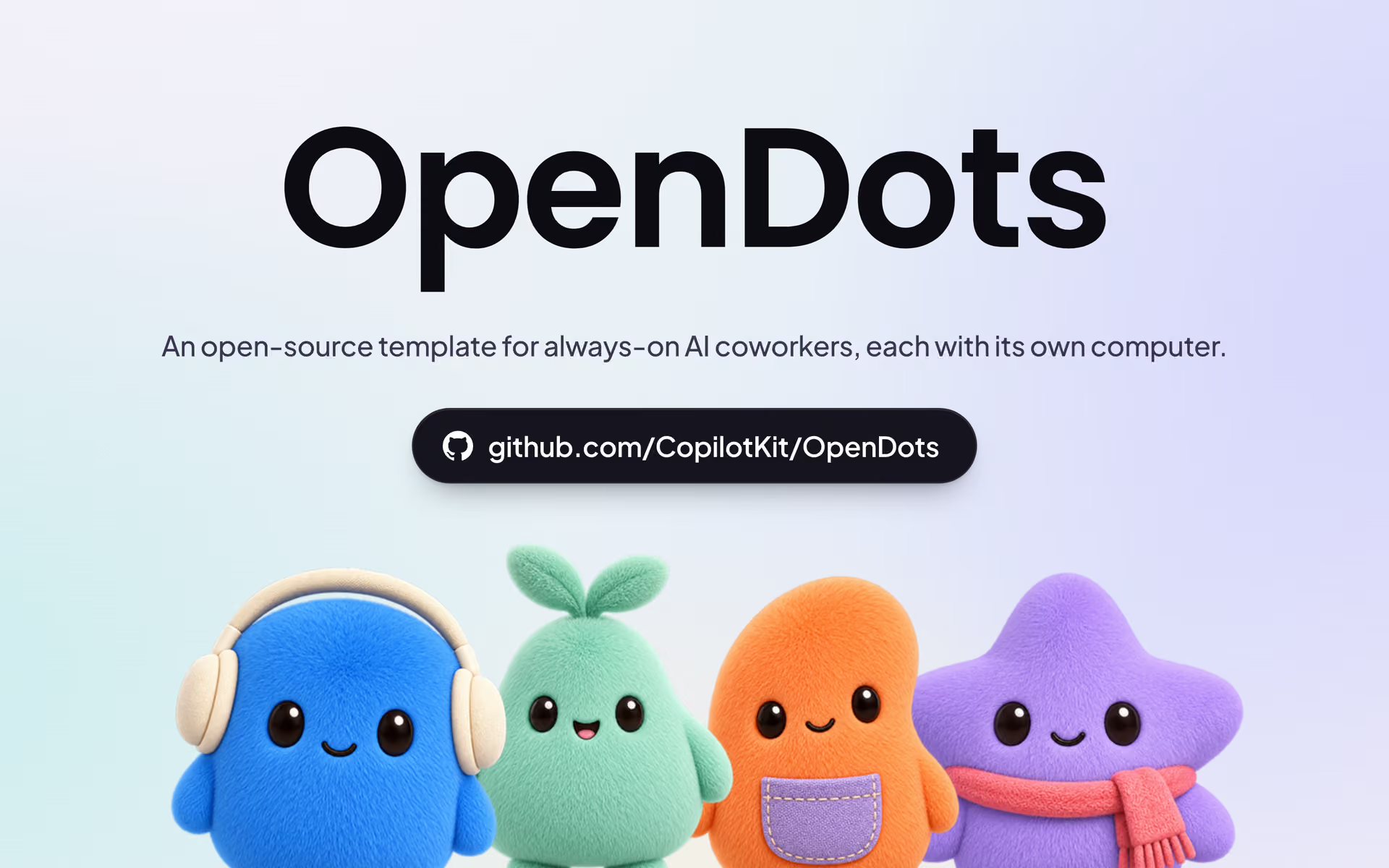
AI assistants are becoming less like chat windows and more like coworkers with a desk, a memory and a list of unfinished work. OpenAI calls its version dots: always-on agents in ChatGPT that can keep making progress between conversations. CopilotKit's OpenDots explores the same product shape from the other direction, as an open-source template that teams can run and adapt themselves.
The names are close, but the decisions behind them are different. One is a managed product. The other is a starting point for building your own agent workspace. Understanding that distinction matters more than comparing screenshots.
What OpenAI Dots changes
OpenAI describes a dot as an always-on agent that takes responsibility for ongoing work. You give it a goal, connect the apps it needs and decide what it may do independently. It can continue working between conversations, use its own cloud computer and return when it has a result or needs judgment. According to the official launch notes, dots are powered by GPT-6 Astra.
That persistence is the important shift. A normal assistant waits for the next prompt. A dot can hold the thread of a project: watch for new information, run recurring work, follow up and preserve the context required for the next action.
OpenAI is rolling dots out gradually to eligible Pro and Business Premium users in supported markets, with Enterprise access in beta and disabled by default. At launch, creation is available through ChatGPT on desktop web and the desktop app, and availability varies by plan and region. The setup guide is the right place to check current eligibility.
What OpenDots is
OpenDots is an MIT-licensed, open-source template from CopilotKit for building persistent AI coworkers. It is explicitly not a hosted product. You clone the repository, configure the model and supporting services, define specialist Dots, connect the channels you need and operate the resulting application.
The template includes several parts of an agent workspace:
- Specialist Dots with separate names, roles, instructions and permitted tools.
- Spaces and Pages for working documents, saved agent output and page-specific conversations.
- Per-Dot computers through OpenBot, including persistent browser profiles, files, shell access and human takeover.
- Human approval flows that pause before saving proposed work.
- Text, realtime calls and Slack as interaction channels.
- Background work, memory and schedules for tasks that extend beyond one chat turn.
The application uses AG-UI to carry streamed messages, state and tool activity between its agents and interface. CopilotKit provides the React runtime and durable conversation layer, while model access is configured separately through an OpenAI-compatible provider.
Managed product versus open blueprint
| Decision | OpenAI Dots | OpenDots |
|---|---|---|
| Product shape | Managed feature inside ChatGPT | Open-source application template |
| Operation | OpenAI operates the service and cloud computer | Your team deploys and operates the application and supporting services |
| Model | Powered by GPT-6 Astra | Configurable through an OpenAI-compatible model provider |
| Customisation | Goals, connected apps and autonomy controls within the product | Source-level control over agents, tools, interface, channels and workflows |
| Data and credentials | Managed through ChatGPT and workspace controls | Stored and handled by the infrastructure and services you configure |
| Time to start | Lower for an eligible ChatGPT account | Higher: development, credentials, services, deployment and ongoing operations |
| Best fit | Teams that want the capability without owning the platform | Teams that need control, custom workflows or a foundation for their own product |
OpenDots is therefore an alternative in architecture and ownership, not a promise of parity. It shows how an always-on coworker experience can be assembled from open components, but it does not remove the engineering and operational work that a managed product absorbs.
The case for OpenAI Dots
The managed route is attractive when speed matters more than infrastructure control. The agent already lives inside a product where conversations, connected apps and review happen. There is no agent runtime to deploy, browser service to isolate or persistence layer to maintain.
For many organizations, that is the sensible default. The business value comes from the workflow the agent completes, not from owning every service underneath it. A managed dot also gives a team one place to configure goals, permissions and autonomy without first designing a control plane.
The tradeoff is that the product boundary is also the customization boundary. Availability, supported connectors, models, usage terms and deployment choices follow OpenAI's roadmap and plan structure.
The case for OpenDots
OpenDots becomes interesting when the agent workspace itself is part of the product or operating model. A team can change the interface, create narrow specialists, define its own tools, choose a compatible model provider and place approval steps exactly where its risk model requires them.
It also provides useful reference architecture. Each Dot can have an isolated computer, credentials stay server-side, and permissions can be scoped by tool. Work performed in the computer can appear inside the conversation, while a human can inspect or take over. Those are important primitives for any agent expected to act rather than only answer.
The cost is ownership. Self-hosting the web application is only one part. Production use also requires identity, authorization, secret management, isolation, observability, backups, upgrades and incident response. The repository's own security guidance says the template is under development, is not security-audited autonomous software and needs additional enforcement for connected multi-user use.
What is ready and what is still early
The OpenDots repository documents working local flows for Spaces, Pages, specialist conversations, browser activity, file creation, shell execution and persistence. It also distinguishes those checks from integrations that still require connected-service verification.
The maintainers describe it as a single-owner starting point. Shared editing, invitations, file uploads, multi-Dot group conversations and automatic delegation are not currently complete product features. Schedules are recurring instructions rather than a full responsibility or event-trigger system.
That candour is useful. OpenDots should be evaluated as a well-developed template and reference implementation, not installed with the expectations applied to a mature hosted service.
Which route should a business choose?
Choose the managed route when the priority is to give a team an always-on agent quickly, using the controls and connected-app ecosystem available in ChatGPT. It is the shorter path from an operational problem to a working assistant.
Consider OpenDots when at least one of these is genuinely important:
- the agent experience must become part of your own product;
- you need source-level control over tools, channels or approval logic;
- your deployment or data boundary cannot fit a managed service;
- you want to experiment with different compatible model providers;
- your engineering team is prepared to operate the full system responsibly.
The deciding question is not "open or closed?" It is which layer should your company own? Owning the code creates options, but it also makes reliability, security and maintenance your job.
Start with the responsibility, not the platform
Before choosing either route, define one responsibility worth delegating. A useful first Dot might prepare a daily operations brief, keep a sales pipeline moving, research and draft a weekly market note, or watch an engineering queue and propose the next action.
Write down the systems it may read, the actions it may take, the decisions that require approval and the evidence it must return. Then evaluate whether a managed Dot can satisfy that boundary or whether the workflow justifies a tailored OpenDots deployment.
Always-on agents make unfinished work part of the product. The strongest implementation will not be the one with the most autonomy. It will be the one whose responsibility, permissions and review points are clear enough that a team can trust it to keep going.
Rotating Technologies helps companies design and deploy agentic systems with the right ownership model, from managed platforms to self-hosted infrastructure. If you are deciding what your first persistent AI coworker should own, talk to us.